If you're anything like me you start your morning with a cup (or a pot) of coffee. It's my favorite way to begin the day and I usually take my last cup outside to enjoy while making my morning gardening rounds. This means the first "kitchen scraps" of the day are coffee grounds. I know a few people who flush this wonderful source of garden magic down the garbage disposal, or worse yet, they throw it away (gasp!). Used coffee grounds are one of the easiest items to reuse in your garden.
1. Add to your compost pile. Just throw them in, filter and all.
2. Add to your vermicomposting bin. Woms have a gizzard (just like chickens) and coffee grounds help them digest food.
3. Use them to fertilize acidic-loving plants such as Azaleas, Rhododendrons, evergrees, and blueberries (to name a few).
4. Coffee grounds are said to repel slugs and snails. Scatter around your plants and you can fertilize and prevent damage at the same time and without the use of chemical products.
5. Keep your cats from using your garden as a potty by spreading coffee grounds and crushed orange peels around your plants.
6. Ants hate coffee grounds. Sprinkle coffee grounds on anthills, around your lawn, and anywhere you see ants forming.
7. Mixing your carrot seeds with dry coffee grounds before planting makes the small seeds easier to sow. Some studies suggest that it may also help to repel root maggots.
8. Use on indoor plants. A small amount scratched in to the soil surface can give your plants a bit of bloost.
9. Coffee grounds make a great mulch for your summer vegetable garden. It's high in nitrogen, making it a wonderful fertilizer for heavy feeders and fast growing vegetables. It also provides phosphorus, potassium, magnesium and copper.
10. Coffee grounds work well as a mulch between pathway pavers. The grounds look beautiful while suppressing weeds and smelling fantastic.
By the way, if you don't drink the last bit of coffee in the pot, don't dump it down the drain-pour it on your plants! Your blueberries (or Rhododendrons) will enjoy it as much as you did.
Be well and happy gardening!
Sunday, April 7, 2013

Friday, March 29, 2013
Chop, chop
Chopping yard debris for my compost bin can be a tough job. The recommendation is to cut your organic material into 1 inch pieces.
My push reel mower and a weed wacker takes care of the grass.
 A leaf vac sucks up and mulches dead leaves and my McCullogh mulcher chops up small branches and other woody materials but nothing works very well with green (wet) or fiberous plants.
 Whats a composter to do?
Well, many thanks to Paul James (remember HGTV's garden guy) for this great tip.
Place your plants in a heavy duty trash can and use your weed wacker to quickly chop everything into small pieces.
 In seconds a trashcan full of bolted radishes (or Arugula, or canna lilies, etc.) is cut down to a manageable size.
 CAUTION: Plant pieces will be flying. Be sure to wear eye protection...long sleeves aren't a bad idea, either.
Be well and Happy Gardening!
My push reel mower and a weed wacker takes care of the grass.


Well, many thanks to Paul James (remember HGTV's garden guy) for this great tip.
Place your plants in a heavy duty trash can and use your weed wacker to quickly chop everything into small pieces.


Be well and Happy Gardening!
Monday, March 25, 2013
Why Waste Water?
In a dry world the true wealth of a man will be how much water he has.
I wish I could remember where I read those words but my memory isn't what it used to be. No matter, the thought has managed to stay with me.
A class in "waterwise" living mapped out the large (dry) picture.
3% of the earths water is fresh and 97% is ocean.
Of the 3% (fresh water) 2/3 of that is glacial or unaccessable.
In a nutshell, there's not a lot of fresh water out there.
A few other notes worth listing:
13 gallons of water per person per day is poverty level (in some parts of the world people exist on even less)
151 gallons per person per day is the U.S. average
40% of residential water goes to outdoor use. Gardens can be very thirsty.
I live in Southern California. With less than 16 inches of rainfall a year our climate is considered semi-arrid. We are constantly hot and dry. So while I can grow fruits and vegetables all year long it takes A LOT of irrigation to do it. What's an environmentalist to do? Conserve, reuse, repurpose and reclaim the water that I use every day.
Here's a list of my day to day "waterwise" living:
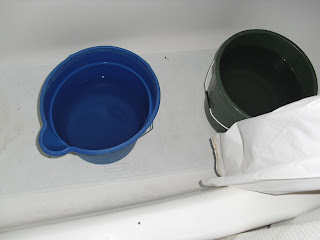
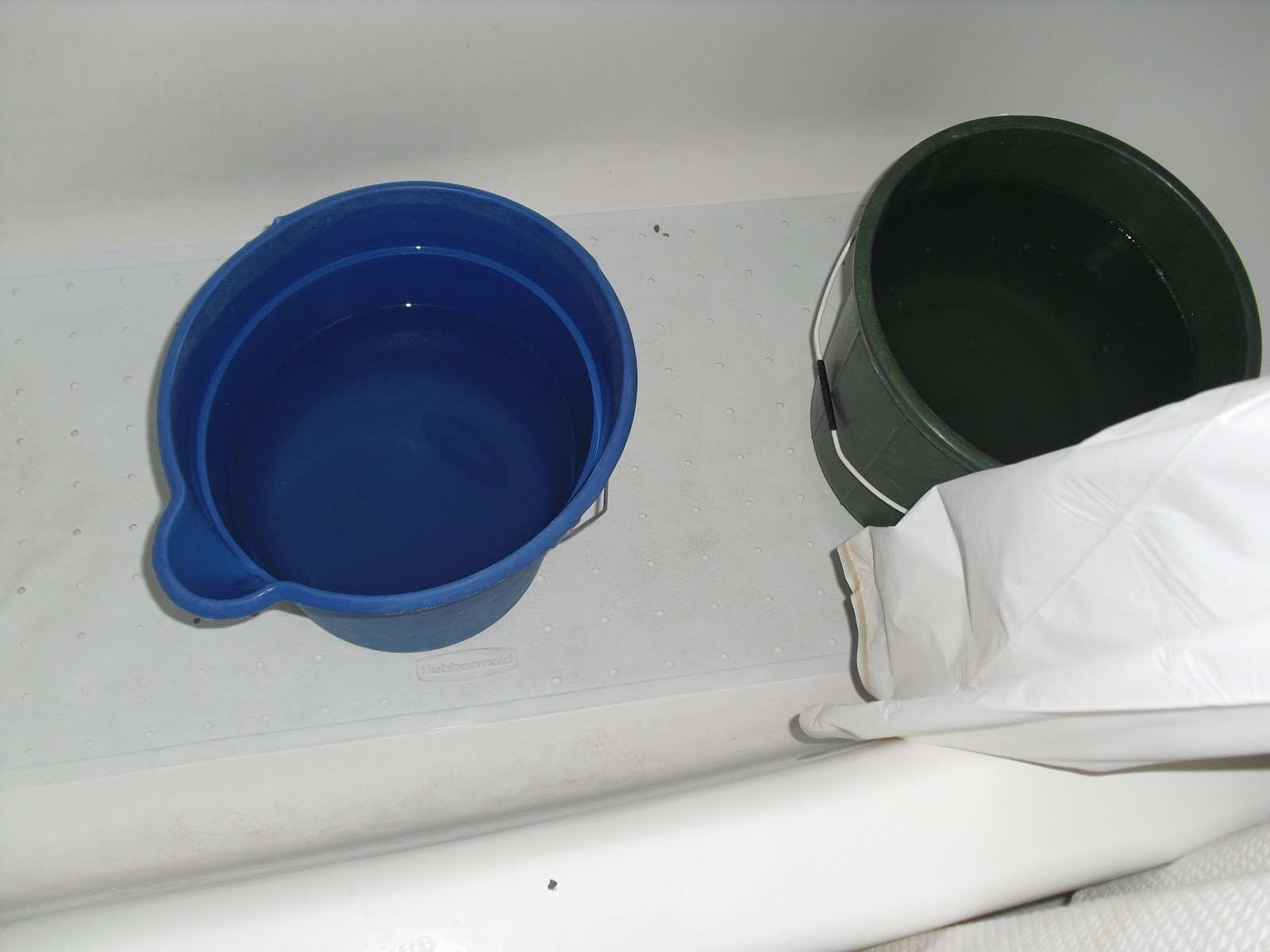
We keep a couple of buckets in the shower. Clean water (water saved during warming) goes on edible crops. Soapy water gets used to flush toilets or gets used on our potted ornamental plants.

My granddaughters bath tub holds soapy water that gets reused, bucket by bucket, to flush toilets, water plants, etc.
.JPG)
I use watering cans or empty containers to collect water I'm warming for dish washing.

I hate letting anything go to waste so once again I reclaim what would otherwise go down the drain. This bucket in the kitchen sink holds liquids (leftover coffee, soda, cooking water, etc.).

The apple tree next to my kitchen door gets much of it's water from what I save in the kitchen.

A pool vacuum hose delivers grey water from my washing machine to my lawn and ornamental garden. I keep it earth friendly by using environmentally safe, plant based detergents.

Rinsing my produce in the garden leaves most of the soil (and some of the pests) outside while giving a drink to the plants below.

Our downspouts are left high enough so that a trash can fits underneath. All the trash cans have tight fighting lids to prevent mosquitoes from entering the water. 5 gallon buckets hold the overflow, and this "uncovered" water gets used first after the rain stops, watering pots, trees, and even just dumped on to the lawn or soil. Water kept on your property will always be appreciated by your plants. When our short rainy season ends the trash cans and buckets get reused in the summer garden.

To save water, and my time and energy while watering, I hang plants off our concrete wall, placing them directly above larger potted plants. I water the top plants and let the draining water take care of the plants below. This works especially well if you put the "thirstier" plant on top and place plants with lower water needs on the bottom.
It can be tough to think of water as a precious resource. It's so easy to turn on a faucet and get all the water we want. But forecasters predict the drought plaguing most of the U.S. (and world) will continue. Fresh water continues to be in short supply. It's never to late (or early) to cut down on the amount we use while reusing what we have.
Be Well and Happy Gardening!
2019 Update: Last summer we purchased an above ground pool to help cool us off during the hot summer months. Our small pool holds almost 900 gallons of water.
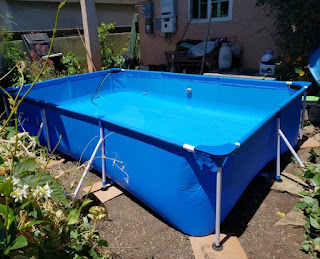
The filter system and pool vacuum are run with solar power and the water is chlorinated to prevent mosquitoes from using it as a breeding area.


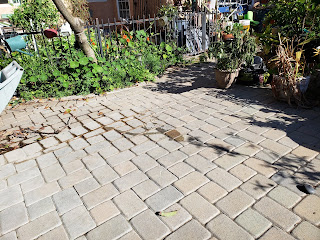
Since it's too cold to swim, I use buckets of the chlorinated water to rinse down the backyard "potty" area after cleaning up after my dogs.


I wish I could remember where I read those words but my memory isn't what it used to be. No matter, the thought has managed to stay with me.
A class in "waterwise" living mapped out the large (dry) picture.
3% of the earths water is fresh and 97% is ocean.
Of the 3% (fresh water) 2/3 of that is glacial or unaccessable.
In a nutshell, there's not a lot of fresh water out there.
A few other notes worth listing:
13 gallons of water per person per day is poverty level (in some parts of the world people exist on even less)
151 gallons per person per day is the U.S. average
40% of residential water goes to outdoor use. Gardens can be very thirsty.
I live in Southern California. With less than 16 inches of rainfall a year our climate is considered semi-arrid. We are constantly hot and dry. So while I can grow fruits and vegetables all year long it takes A LOT of irrigation to do it. What's an environmentalist to do? Conserve, reuse, repurpose and reclaim the water that I use every day.
Here's a list of my day to day "waterwise" living:

.JPG)


It can be tough to think of water as a precious resource. It's so easy to turn on a faucet and get all the water we want. But forecasters predict the drought plaguing most of the U.S. (and world) will continue. Fresh water continues to be in short supply. It's never to late (or early) to cut down on the amount we use while reusing what we have.
Be Well and Happy Gardening!
2019 Update: Last summer we purchased an above ground pool to help cool us off during the hot summer months. Our small pool holds almost 900 gallons of water.
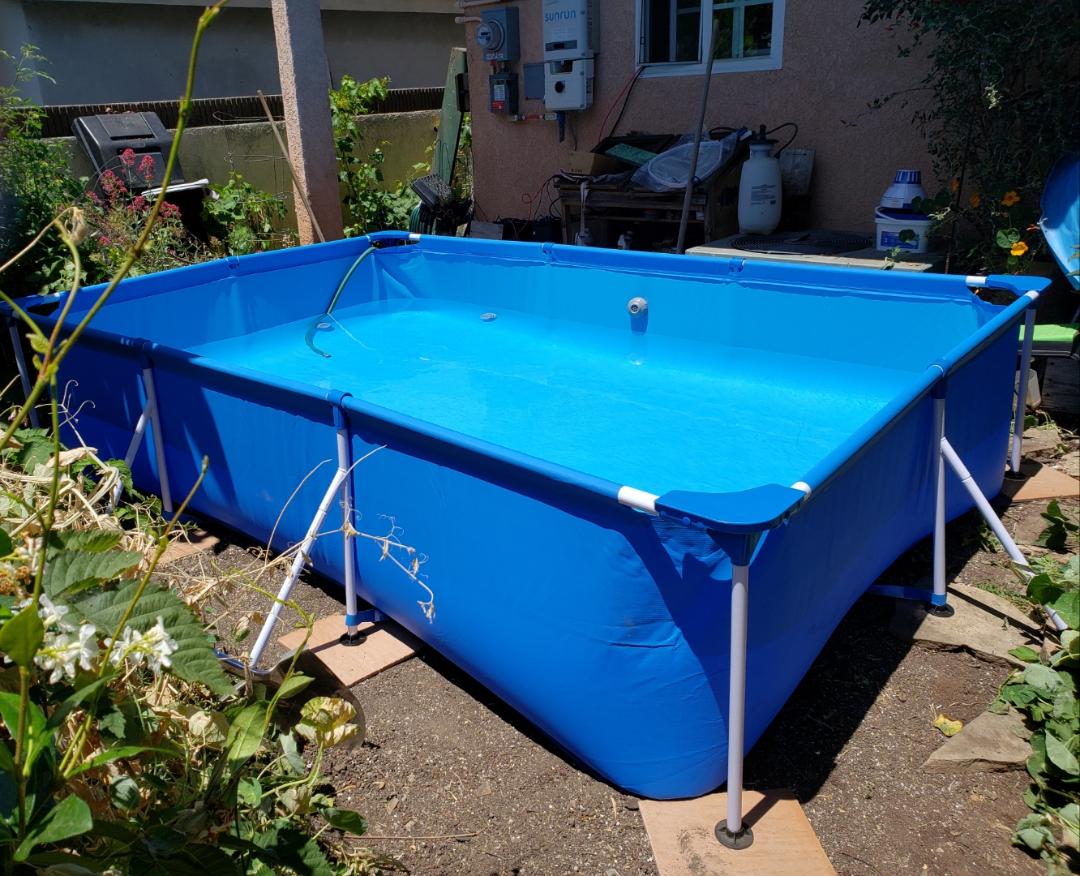
Our summer "cooling" center, but could be
useful for other purposes in an emergency
The filter system and pool vacuum are run with solar power and the water is chlorinated to prevent mosquitoes from using it as a breeding area.
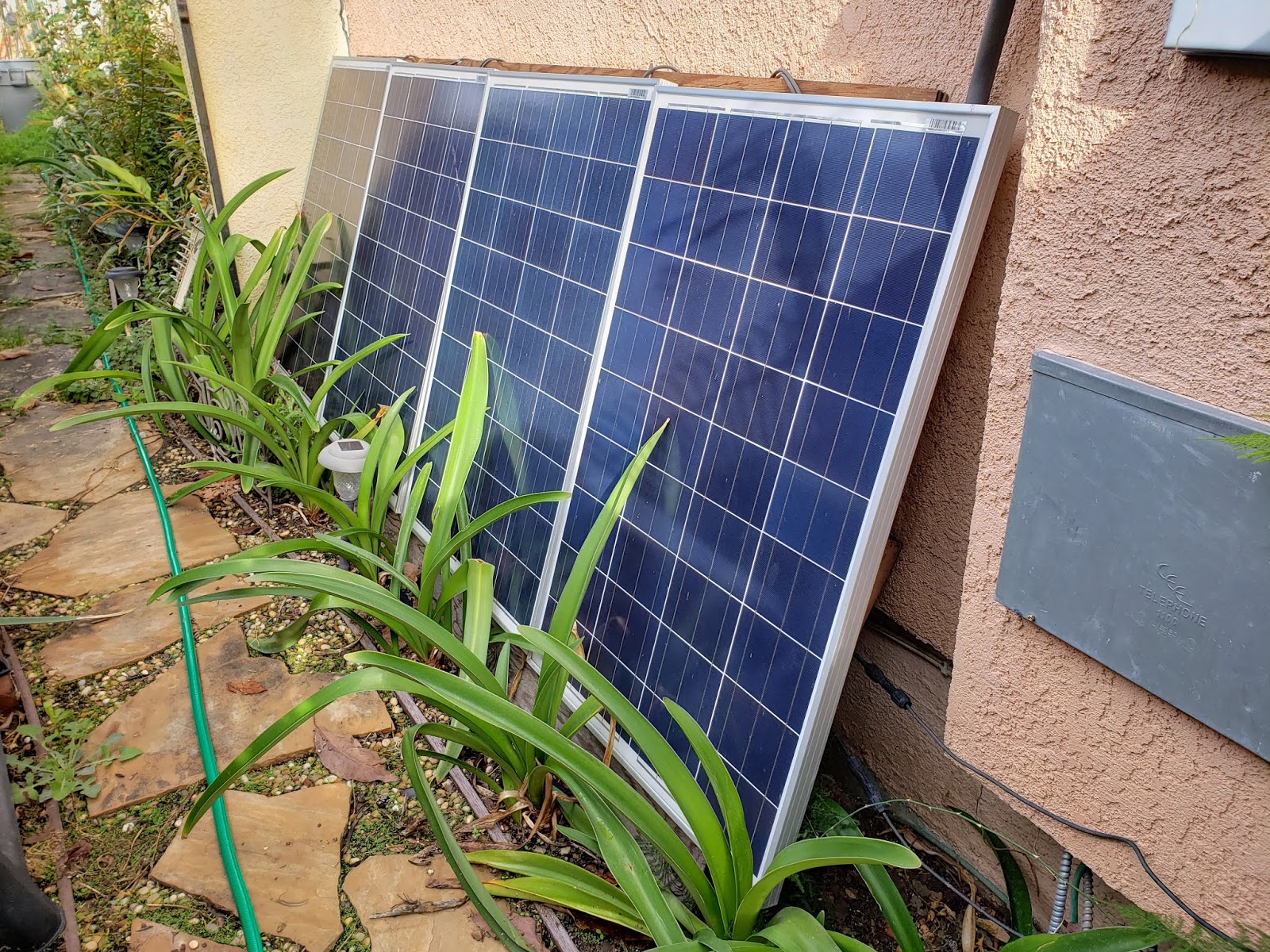
Off Grid Solar Panel system from Costco

Batteries charged by panels to supply electricity
to the swimming pools filter system
Since it's too cold to swim, I use buckets of the chlorinated water to rinse down the backyard "potty" area after cleaning up after my dogs.

Pavers in our backyard
Recently we replenished our half full pool during a day of strong rain by diverting rain from our rain gutters.

A plastic gutter directs water from our roof, through
the down spout and in to a trash can (rain barrel),
on to my boysenberry beds, in to the swimming
pool or out to the flower garden

Spring Flowers!!
A recent tally of my water holding capacity is approximately 2000 gallons with half pool water (chlorinated) and half fresh. While it sounds like a lot, it's used up quite quickly by fruit trees and raised garden beds.
Sunday, February 3, 2013
The Miracles of Mulch
I love using mulch in my garden. It helps control weeds, conserves water and improves the overall appearance of my garden. What I don't love is the cost and hassle of commercial mulch. I guess I'm just too frugal (cheap?) to spend money when there are lots of alternatives right at my fingertips.
I use many different types of mulch in my yard with much of it depending on what is available when I need it.
My first preference is organic mulches. They break down over time adding organic matter that improves soil structure and feeds beneficial soil organisms. A thick layer of organic mulch also cools the soil resulting in the need for less irrigation. My favorite organic mulches include grass clippings, shredded leaves,

"not quite finished compost"

and our dried and shredded Christmas tree.
Most people will tell you to be careful using pine around your plants. Pine needles have a low pH and you'll hear you should only use them around acid loving plants but the reality is that it takes a lot of any one ingredient to change the overall pH of your soil. Use them on your acid loving plants first but if you don't have any plants with those needs don't worry and don't let your Christmas tree go to waste.


Wine corks and landscape stone
You're probably thinking...wow, what a wino! Actually, I do love drinking wine but many of these came from the restaurant I worked for and they would have ended up in the trash had I not taken them home.
Using mulch is one of the most important things I do to save time and money while improving the look of my yard and the health of my plants.
How about you? What kind of mulch do you use?
Be well and happy gardening
I use many different types of mulch in my yard with much of it depending on what is available when I need it.
My first preference is organic mulches. They break down over time adding organic matter that improves soil structure and feeds beneficial soil organisms. A thick layer of organic mulch also cools the soil resulting in the need for less irrigation. My favorite organic mulches include grass clippings, shredded leaves,

"not quite finished compost"

and our dried and shredded Christmas tree.
Most people will tell you to be careful using pine around your plants. Pine needles have a low pH and you'll hear you should only use them around acid loving plants but the reality is that it takes a lot of any one ingredient to change the overall pH of your soil. Use them on your acid loving plants first but if you don't have any plants with those needs don't worry and don't let your Christmas tree go to waste.
When free organic mulch isn't available I switch to inorganic mulch

Landscaping pavers and terra cotta pieces

River Rocks

Wine corks and landscape stone
You're probably thinking...wow, what a wino! Actually, I do love drinking wine but many of these came from the restaurant I worked for and they would have ended up in the trash had I not taken them home.
Using mulch is one of the most important things I do to save time and money while improving the look of my yard and the health of my plants.
How about you? What kind of mulch do you use?
Be well and happy gardening
Sunday, January 27, 2013
Chopped Citrus Keeps Cats Away
We had a bumper crop of citrus this year. Our 14 dwarf trees gave us about 26 dozen limes, oranges and grapefruit and we've been busy eating (and drinking) the fruits of our labors.
While most of my kitchen scraps end up in the compost bins I'm always open to other "green" ideas for getting rid of every day waste.
On a daily basis one of my biggest pest problems is the neighborhood cats who view my raised beds as their personal litter box. Of course this leaves me worrying about the safety of the food I feed my family, especially the produce that doesn't get cooked like lettuce, radishes etc. I have an aresenal of weapons to deter the cats from using my beds including some plastic chicken wire that a neighbor was throwing out.


and thorny rose branches
 It's a constant fight to make my beds as uncomfortable as possible and nothing gives 100% protection.
One method that has provided some help is chopped citrus rinds. The theory seems to be that the cats don't like the smell.
When I have a pile of rinds on my hands this is a quick way of disposing of them while sending the neighborhood kitties on to other pastures.

I cut the rinds into fourths and give everything a few quick pulses in the food processor.

I sprinkle the course rinds around and between the garden plants.

While the citrus rinds were fresh they gave the most protection and for over a week I didn't have any kitty problems. The rinds were less effective as they dried out but no matter, the dried rinds decompose quickly and it's a quick and it's an easy job to chop and spread more, Fresh juice (Mimosa's) anyone?
Be well and happy gardening!
While most of my kitchen scraps end up in the compost bins I'm always open to other "green" ideas for getting rid of every day waste.
On a daily basis one of my biggest pest problems is the neighborhood cats who view my raised beds as their personal litter box. Of course this leaves me worrying about the safety of the food I feed my family, especially the produce that doesn't get cooked like lettuce, radishes etc. I have an aresenal of weapons to deter the cats from using my beds including some plastic chicken wire that a neighbor was throwing out.


and thorny rose branches

One method that has provided some help is chopped citrus rinds. The theory seems to be that the cats don't like the smell.
When I have a pile of rinds on my hands this is a quick way of disposing of them while sending the neighborhood kitties on to other pastures.

I cut the rinds into fourths and give everything a few quick pulses in the food processor.

I sprinkle the course rinds around and between the garden plants.

While the citrus rinds were fresh they gave the most protection and for over a week I didn't have any kitty problems. The rinds were less effective as they dried out but no matter, the dried rinds decompose quickly and it's a quick and it's an easy job to chop and spread more, Fresh juice (Mimosa's) anyone?
Be well and happy gardening!
Tuesday, August 21, 2012
Leftover Lights
I've had these old lights laying in my brick planter for a long time. They don't have any wiring attached so they won't be lighting my pathway any time soon.

After reading this tip in a garden magazine I decided to repurpose them as plant holders. It only takes a few items to put these together, and most of them will be things that you have on hand.
Potting soil or some other soil medium
old outdoor lights
succulants, cactus or other low care plants

If you have a lot of time on your hands you could clean these up and/or paint them, but I just wiped the lights clean.

I removed the bulbs from inside the lights. Many home improvement stores, including Home Depot, will let you drop off your light bulbs and batteries so please don't send these to the landfill.
My peat moss was one big rock so the bulk of my time went to breaking it up into useable pieces.
I added a little vermiculite for extra drainage and filled my little pots with soil.
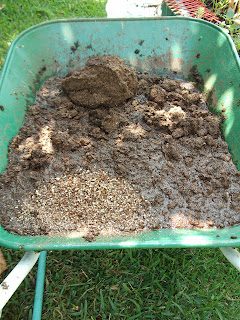

I had a few pots of succulants on hand but most dollar stores have pots of cactus and succulants if you need something quick & cheap. A hole in the center helps save the roots when planting.
 Push the plants in the soil, pressing the soil firmly around the roots.
Push the stems of the lights in the soil and enjoy your designer pots!


Be well and Happy Gardening!

After reading this tip in a garden magazine I decided to repurpose them as plant holders. It only takes a few items to put these together, and most of them will be things that you have on hand.
Potting soil or some other soil medium
old outdoor lights
succulants, cactus or other low care plants

If you have a lot of time on your hands you could clean these up and/or paint them, but I just wiped the lights clean.

I removed the bulbs from inside the lights. Many home improvement stores, including Home Depot, will let you drop off your light bulbs and batteries so please don't send these to the landfill.
My peat moss was one big rock so the bulk of my time went to breaking it up into useable pieces.
I added a little vermiculite for extra drainage and filled my little pots with soil.


I had a few pots of succulants on hand but most dollar stores have pots of cactus and succulants if you need something quick & cheap. A hole in the center helps save the roots when planting.

Push the stems of the lights in the soil and enjoy your designer pots!


Be well and Happy Gardening!
Thursday, April 19, 2012
Concrete Block Tool Holder
Corral your brooms, rakes & shovels with concrete blocks. 4 blocks, stacked one on top of another makes a great tool caddy.

Best of all, the tool caddy can easily be taken apart if you need the blocks for a future project (side table, planter, etc.).
Be well and Happy Gardening!

Best of all, the tool caddy can easily be taken apart if you need the blocks for a future project (side table, planter, etc.).
Be well and Happy Gardening!
Subscribe to:
Posts (Atom)